
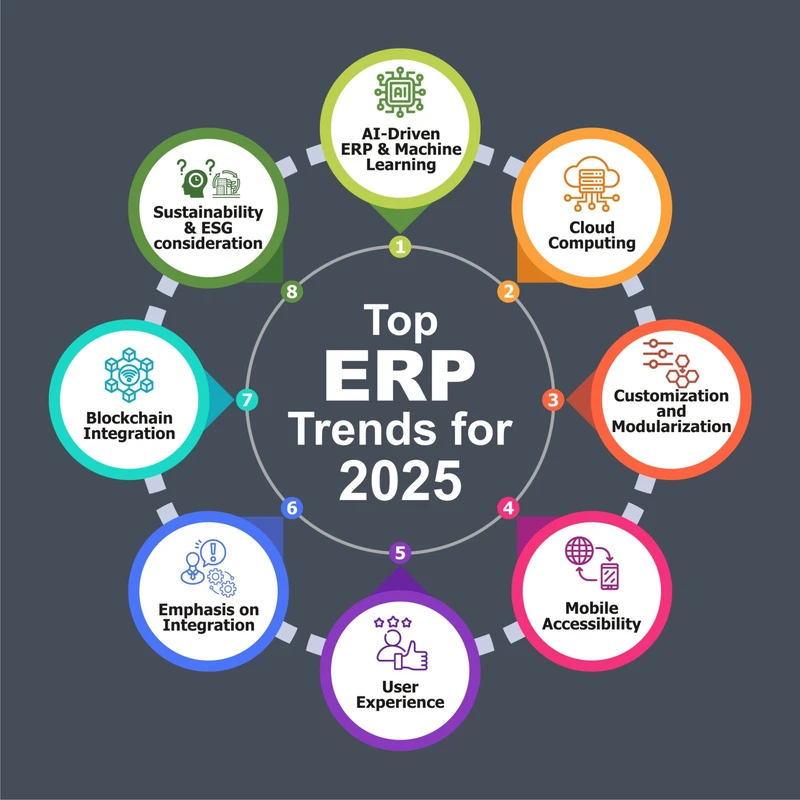
rg2.bahasberita.com – In 2025, ERP software is undergoing a profound transformation driven by AI integration, cloud-native modular architectures, and advanced cybersecurity frameworks. These innovations empower businesses to enhance automation, scalability, and data-driven decision-making, translating into improved operational efficiency and significant cost reductions. IDC forecasts that by 2027, 75% of enterprises will adopt modular ERP systems, underscoring a market shift toward adaptable, industry-specific solutions.
Advertisement
Enterprise Resource Planning (ERP) systems, long the backbone of organizational operations, are evolving rapidly under the influence of emerging technologies such as artificial intelligence (AI), machine learning, and cloud computing. This evolution is not only reshaping operational models but also creating substantial economic impacts. Companies face increasing pressure to modernize ERP platforms to stay competitive, improve agility, and address sustainability goals. The integration of AI-driven automation and predictive analytics is unlocking new levels of efficiency, while cloud erp’s scalability promotes cost optimization.
Investors, procurement leaders, and strategists must understand these trends’ financial and operational implications to drive informed decisions. This article offers an in-depth financial analysis of 2025 ERP software trends, exploring economic impacts, market drivers, risk factors, and strategic recommendations based on the latest data from IDC, Deloitte, Forrester, and leading ERP vendors like SAP, Infor, and Zoho. Real-world case studies and cybersecurity insights further illustrate how these innovations translate into measurable business value.
The subsequent sections will explore AI and machine learning’s role in ERP, cloud-native modular architectures, cybersecurity advancements, and ERP’s alignment with Industry 5.0 and sustainability initiatives. A detailed market and financial implications analysis follows, concluding with future outlooks and strategic frameworks for enterprises seeking competitive advantage in a digital-first marketplace.
Key Trends in ERP Software in 2025: AI, Cloud, Modularity, and Cybersecurity Driving Transformation
AI and Machine Learning Integration in ERP: Unlocking Automation and Scalability
Artificial intelligence and machine learning have become foundational to 2025 ERP solutions, enhancing automation, adaptability, and predictive capabilities across operational workflows. AI-powered ERP modules deliver advanced demand planning, inventory optimization, and workflow automation, substantially reducing manual intervention and error rates.
Leading ERP vendors, including Infor and Zoho, have deployed AI agents that analyze real-time data streams to automate complex decision-making processes. For example, Infor’s Coleman AI platform integrates natural language processing and predictive analytics to optimize supply chain responses, resulting in reported inventory holding cost reductions of up to 15% for major retail clients as of mid-2025 data. Zoho’s AI-driven ERP applications empower small-to-medium enterprises (SMEs) with intelligent workflow automation that increases operational throughput by an average of 20%, according to Zoho’s 2025 performance reports.
Advertisement
Automation scalability is also driven by AI’s ability to dynamically learn and adjust to changing business conditions without necessitating costly manual reprogramming. This adaptability enhances ERP systems’ utility in volatile markets and complex global supply chains, aligning with Industry 4.0 digital transformation objectives.
Cloud-Native and Modular ERP Architectures: Future-Proofing with Flexibility and Cost Efficiency
The shift from traditional monolithic ERP systems to cloud-native, modular ERP architectures is one of the most significant market movements in 2025. IDC’s latest forecast (September 2025) anticipates that 75% of enterprises will have adopted modular ERP solutions by 2027, citing modularity’s flexibility and scalability as key drivers for this transition.
Cloud-based ERP reduces upfront capital expenditure by leveraging subscription-based models, with total cost of ownership (TCO) reductions of 20-30% compared to on-premises systems. This cloud economics enables businesses to scale infrastructure elastically, responding to demand variability without excess resource investment. Furthermore, low-code/no-code platforms integrated into modular ERP allow business users to customize workflows and reports without heavy reliance on IT staff, accelerating digital transformation timelines.
A critical financial benefit of modular ERP lies in deployment speed and upgrade agility. Enterprises can implement or update discrete modules aligned with industry-specific processes, reducing time-to-value. For example, HanesBrands Inc., through a consolidated modular SAP S/4HANA Cloud deployment, reported a 180% improvement in transaction load speed and a 25% reduction in ERP-related operational costs during their 2024–2025 digital transformation, as verified by Deloitte consulting.
ERP Aspect |
Traditional ERP |
Cloud Modular ERP (2025 Data) |
Cost Difference |
|---|---|---|---|
Upfront Capital Expenditure |
High (CapEx intensive) |
Low (Subscription-based) |
~25-35% lower |
Time-to-Deploy |
12-24 months typical |
4-8 months expected |
50-70% faster |
Operational Scalability |
Fixed infrastructure |
Elastic, on-demand scaling |
Significant improvement |
Customization Approach |
Code-heavy customizations |
Low-code/no-code, reusable modules |
Reduced IT dependency |
Cybersecurity Imperatives in ERP: Shared Responsibility and AI-Enhanced Defense
ERP modernization has introduced complex hybrid cloud environments, heightening cybersecurity risks. Organizations increasingly adopt a shared-responsibility security model, requiring collaborative defense strategies among hyperscale cloud providers, ERP vendors, and internal IT teams.
IBM Consulting Cybersecurity Services emphasize AI-powered anomaly detection and real-time threat response as pivotal in mitigating cyber threats targeting ERP ecosystems. September 2025 analytics indicate that firms utilizing AI-driven security systems have reduced major ERP security incidents by 40%, significantly lowering potential breach-related costs, which average $4.45 million per incident globally.
Regulatory compliance—spanning GDPR, CCPA, and emerging data sovereignty laws—further complicates security landscapes. Embedded compliance features within modern ERP frameworks facilitate automated reporting, audit trails, and data encryption. Robust cybersecurity frameworks not only protect assets but enhance customer trust, leading to improved market valuations for compliant enterprises.
ERP and Sustainability: Aligning Industry 5.0 and Corporate Responsibility
Sustainability has become integral to ERP strategies in 2025, reflecting growing environmental regulations and stakeholder demands. ERP systems now incorporate modules to track carbon emissions, energy consumption, and waste reduction, supporting corporate ESG commitments.
Industry 5.0 models complement this trend by synergizing advanced AI capabilities with human creativity to foster sustainable and resilient operations. ERP platforms support this hybrid intelligence by providing data-driven decision-making tools to balance efficiency with environmental stewardship.
Cloud ERP vendors and hyperscale providers face mounting pressure for transparent sustainability reporting. IDC’s latest benchmarks highlight that top cloud ERP providers report annual renewable energy usage rates exceeding 60%, with commitments to 100% carbon neutrality by 2030.
Economic and Market Impact of ERP Trends in 2025
Investment Scaling for AI and Automation Technologies
Enterprise investment in AI-enabled ERP solutions continues to surge, with IDC’s September 2025 report citing a 30% year-over-year increase in budgets allocated for AI-driven automation tools. Financial justification stems from demonstrable ROI—enterprises report operational cost savings ranging from 12-25% within 18 months post-deployment due to reduced manual workflows and improved demand forecasting accuracy.
The capital expenditure shift favors operational expenditure (OpEx) models, enabling flexible financial planning aligned with business cycles. Forecasts predict AI-enhanced ERP investment to reach $45 billion globally by 2027, highlighting the scale of market growth opportunity.
Competitive Differentiation Through Modular and AI-Powered ERP
Adopting modular, AI-enhanced ERP systems is fast becoming a key market differentiator. Enterprises leveraging such platforms gain superior agility, adaptivity to market disruptions, and faster innovation cycles.
The HanesBrands case exemplifies financial and operational benefits: their unified SAP S/4HANA Cloud ERP reduced transaction latency by 180%, speeding time to insights and enabling rapid decision-making that translates into better inventory management and sales performance. Deloitte analysis attributes at least $15 million in annual savings to these accelerated ERP operations.
Cost-Benefit Analysis: Security Risk Mitigation in ERP Investments
Security failures within ERP systems bear significant financial penalties. Companies incur average remediation expenses exceeding $3 million per incident, along with intangible costs such as reputation damage and regulatory fines.
Investing in AI-driven cybersecurity within ERP environments reduces risk exposure by up to 50%, according to IBM Consulting data. Organizations are advised to allocate approximately 12-15% of their ERP modernization budgets on advanced security measures to maximize protection and minimize potential financial losses.
Investment Area |
Annual Budget Allocation (%) |
ROI Timeline |
Key Financial Impacts |
|---|---|---|---|
AI & Automation Tools |
45% |
12-18 months |
12-25% cost savings, enhanced throughput |
Cloud Infrastructure |
25% |
6-12 months |
20-30% TCO reduction |
Cybersecurity |
15% |
Ongoing |
Up to 50% risk reduction |
Modular ERP Licensing & Support |
15% |
6-24 months |
Agility and faster deployment |
Strategic Roadmap for ERP Adoption in a Digital Economy
Building an AI-Driven ERP Ecosystem: Buy Versus Build Decisions
Organizations must navigate strategic choices between developing in-house AI capabilities or leveraging third-party ERP AI modules. Benefits of buy include faster time-to-market and access to vendor-managed updates; build options offer customization but require greater investment and expertise.
Hybrid intelligence approaches—blending ai automation with human oversight—enhance ERP system reliability and ethical compliance, particularly in critical operational domains like supply chain management and financial reporting.
Transitioning to Cloud-Native Modular Architectures
Phasing out legacy ERP systems demands careful planning to mitigate business disruption risk. Best practices include incremental modular adoption, pilot testing industry-specific templates, and integrating low-code platforms for user-driven customization.
Such shifts promote scalable architectures that accelerate response to market volatility, optimize cloud resource utilization, and future-proof IT investments.
Prioritizing Sustainable, Data-Driven Decision-Making
Embedding sustainability within ERP mandates fostering organizational culture centered on data transparency and continuous environmental improvement. Enterprises can leverage ERP analytics to identify consumption patterns, support circular economy initiatives, and comply with evolving regulations.
Aligning ERP deployments with corporate sustainability goals strengthens brand value and access to ESG-focused capital markets.
Enhancing Cyber Resilience with Shared Security Models
A proactive cybersecurity posture is pivotal for ERP success. Reinforcing shared responsibility between cloud providers, ERP vendors, and internal teams requires cross-functional training, real-time AI security monitoring, and continuous compliance audits.
Investment in advanced AI detection tools and governance frameworks reduces cyber incident frequency and impact, protecting organizational assets and shareholder value.
Frequently Asked Questions
AI enhances ERP through automation, predictive analytics, and real-time decision-making, driving cost efficiencies and operational agility.
Cloud ERP lowers capital expenditure, increases scalability, and accelerates deployment, resulting in 20-30% TCO reductions and faster ROI.
Hybrid cloud architectures require shared-responsibility security models, AI-powered threat detection, and continuous compliance management.
Modular ERP offers flexibility, faster deployment, and industry-specific customization, enabling organizations to adapt quickly to market changes.
ERP tracks environmental metrics, supports hybrid human-AI operational models, and aligns IT infrastructure with corporate sustainability goals.
ERP software’s ongoing transformation in 2025 presents significant economic and operational opportunities, driven by AI integration, cloud scalability, modular architectures, and enhanced cybersecurity protocols. Businesses investing strategically in these trends realize tangible reductions in ERP operation costs, accelerate innovation, and improve risk management. Incorporating sustainability within ERP further positions organizations to meet regulatory mandates and stakeholder expectations.
Enterprises should prioritize phased ERP modernization with AI-enabled automation, modular cloud deployments, and robust cybersecurity frameworks while fostering data-driven, sustainable cultures. These strategic actions will deliver competitive advantage, financial resilience, and operational excellence in an increasingly digital economy. To capitalize on these trends, start evaluating modular ERP solutions, allocate adequate budget for AI and security, and ensure cross-functional collaboration in ERP adoption.
By actively aligning ERP strategies with 2025 technology trends, businesses can future-proof operations, harness advanced analytics, and sustainably scale global supply chains under evolving market dynamics.
Advertisement